Showing posts with label informative. Show all posts

Tuesday, February 16, 2016

The Incredible Eddible Egg..plant


Common Eggplant

I used to think that I was not a big fan of eggplant.  I used to think that I did not like the taste and that eggplant was one of those vegetables that only vegetarians and hippies ate.  Like most things I did not like to eat it was only I had never experienced them prepared well.  It was not until I shared a meal at a Chinese restaurant that I experienced eggplant in a way that I not only liked, but loved.  The dish was simply Japanese eggplant stir-fried with the "chef's special sauce".  I tried the dish if only for curiosity sake and my life has not been the same since.  While the sauce of the dish was a large portion, I fell in love with eggplant itself.  It was soft and almost creamy with an earthy flavor to it and non of the bitterness that I usually thought accompanied eggplant.

So what exactly is an eggplant?  The eggplant, also known as an aubergine, is a fruit (technically a berry) that is consumed like a vegetable that comes from a plant originating in India.  The eggplant has been known to Asia for over two millennia and been cultivated in China since 500 B.C.  Arabs and Persians introduced it to Africa before the middle ages and it was from there that the eggplant was brought to Italy around the 14th century.  The first varieties of eggplant were so bitter that Europeans initially thought it caused insanity and kept it mainly for its ornamental purposes.  Only after years of cultivation and selective breeding has the eggplant improved in flavor.


Japanese, white and common Western Eggplants
 
There are multiple varieties of eggplants.


There are many different varieties of eggplant with Asian and western being the most commonly available.  Asian varieties are either long and thin or round with skin colors ranging from creamy white to deep purple.  Western eggplants, the more common one in the US, are shaped like a like a big pear with shiny lavender to purple-black skin.  The eggplant grows on a three foot high plant that bears purple-blue flowers.  The yellowish flesh of the eggplant is dense and spongy with a bland flavor that absorbs other flavors well.  Eggplants contain small brown seeds that are edible. The skin is also edible, but can be quite bitter in certain varieties.  Younger and smaller eggplants have less seeds and tend to have skin that is more tender and less bitter.

Eggplant flower


In order to choose a good eggplant look for one that is plump, firm, and heavy. It should be free of blemishes with smooth shiny skin.  Fruits with wrinkled or spotted skin are likely to be old and bitter tasting.  Press the skin lightly to check for ripeness.  If the imprint remains, then the fruit is ready.  Asian eggplants tend to softer than western ones.  Eggplants are available all year long, but their peak season is during the late summer. 

Now that you know what an eggplant is and how to pick one, what do you do with it?  Eggplants are wonderfully versatile and lend themselves to all manner of dishes and cooking methods.  Eggplant can be grilled, baked,stuffed, au gratin, purred, steamed, fried, or sauteed.  It is delicious hot or cold and makes a wonderful addition to any dish or serve as the main ingredient.  Eggplant plays a pivotal role in Asian and Mediterranean cuisines where it is often paired with tomatoes, garlic, and olive oil.  Some of the more commonly known eggplant dishes are moussaka, ratatouille, baba ganoush and eggplant Parmesan.

Eggplant Hors D'oeuvres

Stuffed Eggplant

Whole Eggplant Being Grilled

Moussaka

Roasted Eggplant


When preparing your eggplant is is important to keep in mind that the flesh of the fruit quickly discolors when cut.  Cooking it soon after it is cut or sprinkling it with lemon juice will help avoid that.  If the eggplant is large sprinkling the pieces  with salt and letting it sit for at least thirty minutes will help draw out some of the moisture from it as well as some of the bitterness.  This process also helps to keep the eggplant from absorbing too much oil during the cooking process.  Soaking the fruit in water will also draw out some of the bitterness as well as peeling it since most of the bitterness is concentrated just under the skin. 

Sliced Eggplant Being "Salted"


Eggplant bruises easily so it should be handled carefully.  It is also sensitive to temperature fluctuations.  Fresh eggplants should be stored in a perforated plastic bag in the refrigerator where they will keep for about a week.

Hopefully this post inspires someone who has not had or has not prepared eggplant to get adventurous with this versatile fruit/vegetable.  Not only is it delicious, it is good for you.  So get out there and try the incredible, edible, eggplant!

Tuesday, May 5, 2015

What is Cinco de Mayo really?


 So today is May fifth... So what?  To a lot of people it is an excuse to have a good time, throw a "fiesta" and imbibe some margaritas.  However I am willing to bet that most people don't know, don't care, or are misinformed about significance of this day.  It is NOT Mexico's independence day.  That falls on September 16th.  Cinco de Mayo (known as El Día de la Batalla de Puebla in Mexico)  is the celebration of the Mexican army unlikely victory over the army of France in the Battle of Puebla.  The funny thing about this holiday is that it is not really a major holiday in Mexico.  It is really just a regional holiday celebrated primarily in the state of Puebla.  You are probably asking yourself why is this history lesson in a food blog.  Well, I figured that since Cinco de Mayo is really about Puebla, why don't we get to know some of the wonderful cuisine from this great state in Mexico.


The most famous dish coming out of the state of Puebla is mole Poblano.  As I have discussed in a previous entry, there is a wide variety of mole sauces in Mexico.  However, mole Poblano is the one that is most distinguished and well known.  It is the prototypical mole sauce everyone imagines when thinking of mole.  This mole typically has a rust red to dark brown color with well over twenty ingredients including several types of peppers, peanuts and most notably chocolate.


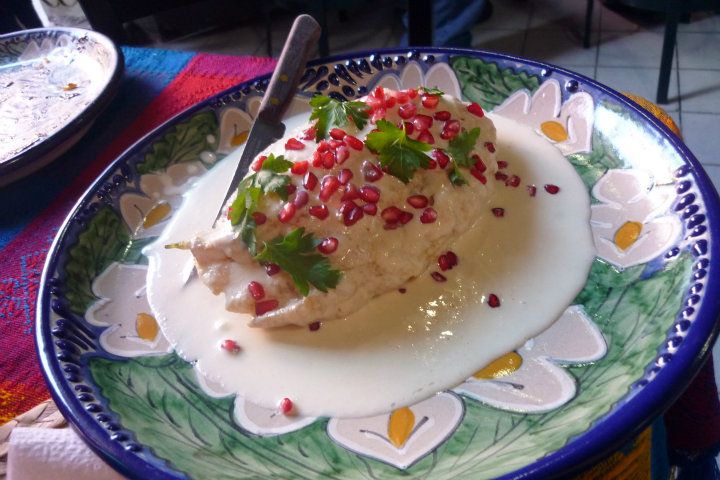
Another typical dish of Puebla is the Chiles en Nogada.  This dish consists of a poplano pepper stuffed with meat (picadillo) much like a typical chile relleno.  However, instead of being topped with tomato sauce after being battered and fried, the stuffed poblano is topped with a white walnut sauce and pomegranate seeds.  The green chile, white sauce, and red seeds give reference to the colors of the Mexican flag.  Even though Chiles en Nogada was born in Puebla this dish has been adopted as a source of national pride.


Mexico is filled with small dishes called antojitos.  Puebla is most well know for its chalupas and molotes.  A chalupa is made by pressing a thin layer of masa dough around the outside of a small mold, in the process creating a concave container resembling the boat of the same name. They are  then deep fried to produce crisp, shallow cup which is then filled with a variety of ingredients.


Molotes are small masa based stuffed antojitos slightly resembling a small empanada.  Molotes are filled with basic ingredients such as meat or potatoes to more exotic ingredients such as corn fungus or squash flowers. 


Puebla is also well known for its sweets.  The most well know candy coming from Puebla is the Camote Poblano or sweet potato candy. These candies are made with pureed sweet potatoes mixed with sugar and a variety of flavorings. They are hand-rolled and wrapped in wax paper. Dulces de camote also date back to the colonial period in Puebla.


Another great candy is know as jamoncillo.  This candy comes in different varieties depending on what part of the country you are in.  However in Puebla the jamoncillo is referred to a candy made with pumpkin seed paste and usually comes in a bar form with a red stripe.


And what would a good Cinco de Mayo celebration be without libations?  Puebla has some great offerings in that department at well.  First off is the classic nevado which is most like a margarita.  A nevado is frozen cocktail comprised of fruit juice and a little liquor.

Another drink native to Puebla would be the acachul.  This drink is derived by fermenting local wild chapulin cherries.


So now that you know a little more about the history of Cinco de Mayo, do yourself a favor.  Instead of just eating the typical fare of guacamole, enchiladas and margaritas, go and find some excellent cuisine from the state of Puebla!