Showing posts with label drink. Show all posts
Wednesday, July 29, 2015
Sweet & Spicy Summer Slushy
We right smack in the middle of summer and in case you have not noticed or been away at Antarctica, IT IS HOT! One of my favorite ways to cool off and have a delicious and healthy snack is to make myself a sweet and spicy slushy. What I love about this recipe is that it is highly customizable. If you don't like any aspect of it (such as the fruit used, or the spicy seasoning) you can omit or change it! Here are some of the things you will need:
FRUIT!! Pretty much any fruit you enjoy can work for this. You can mix and match as you like. For this version I used fresh peaches, blueberries and strawberries. Another popular mix I like to use is oranges, pineapple and mango. If you don't want to bother with fresh fruit or it is not in season you can always use frozen fruit.
You will also need to use some kind of liquid to help make your slushy, well, slushy. I like to use juice that compliments the fruit. In this case I used a blueberry pomegranate acia. If juice is unavailable, plain water is always an option. Just keep in mind it will not add an extra flavor.
For the seasoning I love to use just a bit of sweetener (I use Splenda to avoid added sugar) and a combination of the salty spicy condiments called chamoy and Tajin. These last two are completely optional if those flavors are not your thing. The sweetener helps bring out the flavor of the fruit.
As far as hardware goes, you will need a blender, a long spoon, and several glasses to pour your slushy into.
So, to review, here is what you need to make your slushy:
approx, 2 cups of fruit fresh or frozen.
1- 1 1/2 cups of liquid
1-2 tbsp sweetener
1-2 tbsp each of Tajin and chamoy
1-1 1/2 cups of ice
These ratios are not set in stone. You can play around with them to your own personal tastes. If you want a sweeter slushy, then add more sweetener. If the idea of adding the Tajin or chamoy does not suit your tastes, then you can leave it out. The point of this is to find your slushy flavor profile. These are just guidelines.
The first step to make your slushy is to put your fruit in the blender. I like to add it first because it it soft and will blend well at the bottom vs the hard frozen ice. If you are using frozen fruit, I would use less ice and perhaps a little more liquid. It is also a good idea to cut the larger fruit into smaller pieces as they will blend better.
Next add your sweetener as well as the Tajin and chamoy.
After that add the liquid as well as the ice.
Now just blend away!
Make sure to check the consistency of your slushy. The long spoon serves this purpose as well as giving you a way to taste test your concoction. If the slushy is too stiff and hard add more liquid. If it is too loose, add more ice.
The last step is my favorite. After you have gotten your slushy how you want it, serve and enjoy!
Lastly I will leave you with some suggestions for variations on this simple treat. My personal favorite is using the Dole frozen tropical fruit blend with orange juice as my liquid. Berry blends also work really well together. Lastly, I have found that for the more adult readers out there, this is a great way to make a delicious frozen sangria. Just use your favorite bottled sangria with maybe a little bit of orange juice and whatever fruit you would normally enjoy with said sangria. Give it a whirl in the blender and there you go!
Sunday, April 26, 2015
Wine Bottle Opening: A How To
Wine is good. A lot of people enjoy wine. But how many know how to properly open a bottle? This thought occurred to me while I was attending a function hosted by a friend of a friend. During this great social event we sampled a great many wines from different countries. As more and more bottles were opened it became very apparent that our gracious host had no idea how to properly open a bottle of wine. Not wanting to be rude I kept my mouth shut and at the end of the day the bottles were opened and we were able to enjoy the wine. But I was still amazed at the lack of this simple knowledge.
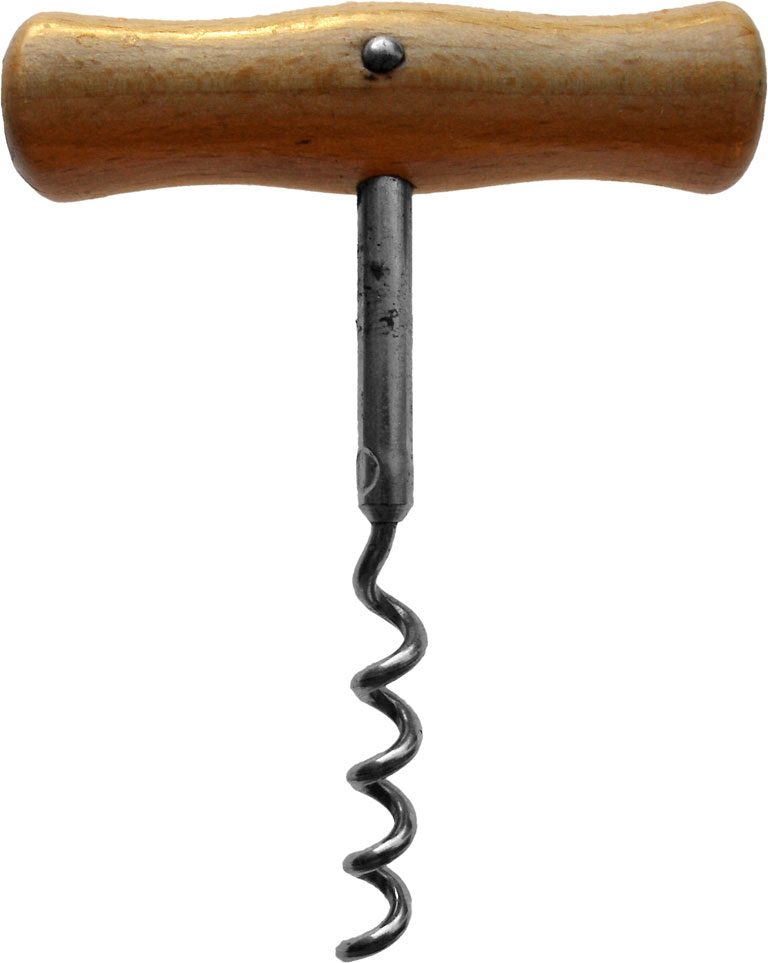
Before we get into the nuts and bolts of how we have to review hardware. Nowadays there is a multiplicity of options to get your bottle open. The basic corkscrew is just a piece of metal twisted in a helix fashion (known as the worm) fixed to a handle.
Next we have the wing corkscrew. It is also known as the butterfly or angel corkscrew. The name is due to the dual levers that resemble a pair of wings.
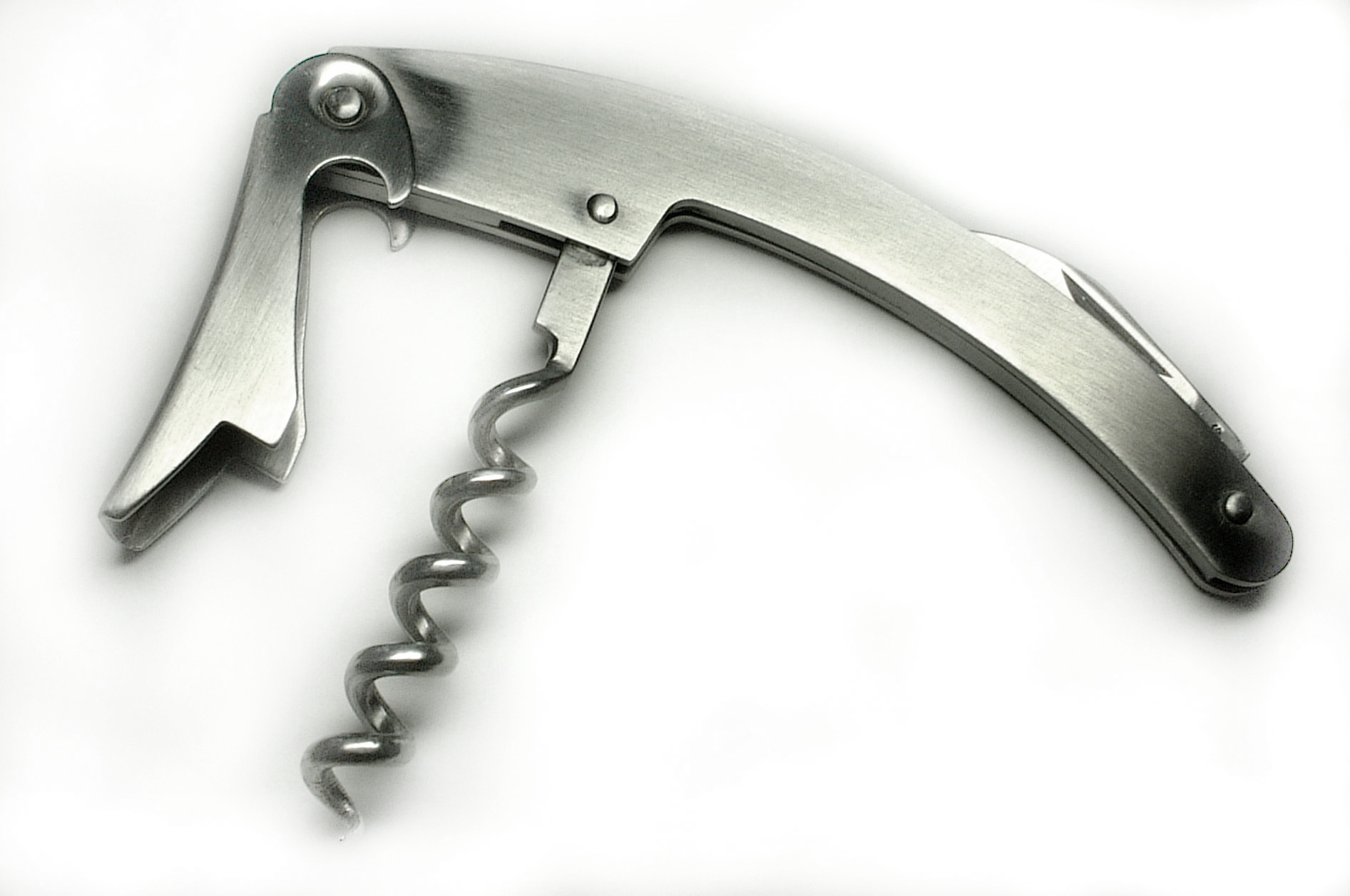
A more complicated wine opening apparatus is known as the sommelier knife, waiter's friend, or wine key. This corkscrew resembles a small pocket knife with the worm being folded into the handle when not in use. The wine key also has a metal arm that folds to cover the worm and serves as a lever when opening the bottle.
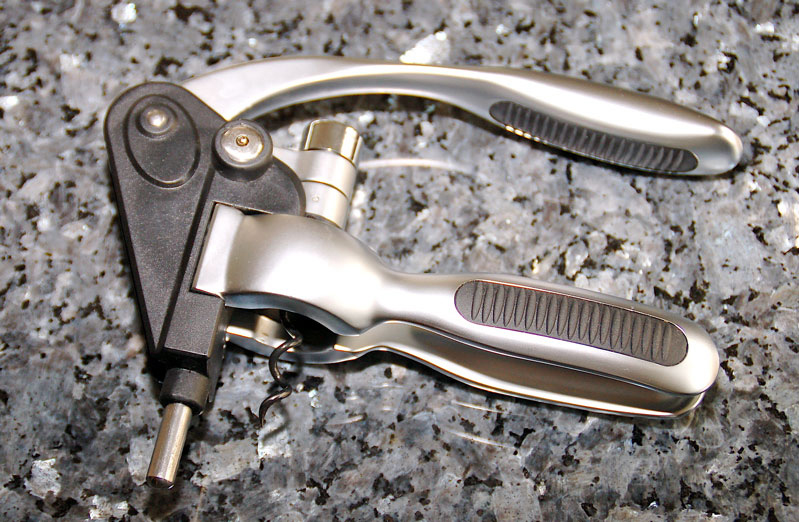
The last device I will be discussing is a lever or rabbit corkscrew. This device uses a pair of handles which are used to grip the neck of the bottle, and a lever which is simply pressed down to twist the screw into the cork, then lifted to extract the cork.
First lets take a brief look at the anatomy of a bottle. The bottle consists of a neck, shoulder, body, and the heel or punt. The parts we are concerned with are from the neck up. The neck is narrower than the rest of the bottle so it may hold the stopper, often known as a cork due to cork being the primary material used to make the stopper in the past. The opening is also called the finish and often has a slightly wider ring known as the collar. The collar is an important part to opening a bottle of wine.
The first step to opening a bottle of wine, no matter which device you use is to remove the foil covering the neck. More specifically it is only necessary to remove the part covering the finish, or just from the collar up. Completely removing this foil allows the wine to flow easily from the finish of your bottle. The best way to remove the foil is to simply use a run a small knife around the bottle at the tip of the collar. This will score the foil so that it may be peeled off. A wine key more often than not has a small blade attached to it for this purpose.
![]() |
| This model has two small teeth imbedded in the body. |
Once the foil has been removed it is time to extract the stopper. The basic corkscrew requires that the user grips the handle and screws the metal point into the stopper then use brute strength to pull out the stopper. The wing corkscrew facilitates this by using a mechanical means to remove the stopper. As a person screws the worm into the stopper, the levers, or wings, lift up due to the dual gears. Once the worm is fully inserted the user simply needs to pull down the levers and the stopper will lift out of the bottle. The gadget that is probably the easiest, fastest, but also the most cumbersome and expensive is the lever corkscrew. To use this device a person simply need to place the worm over the stopper, lower the lever and then lift. The corkscrew does the rest.
The device that requires the most skill to use, but which I consider to be the most elegant, is the wine key. It is a nuanced mechanism that combines form and function. It is small enough that it can be carried in a pocket. That is why is also known as a waiter's friend, since waiters will carry one on their person with ease. Its design is simple enough that it can be made inexpensively. The "key" is knowing how to use one. The truth is that it is really not that hard once you know what you are doing.
After the foil has been removed the first step is to open the key so that it resembles a basic corkscrew.
Next screw the worm into the stopper until it is firmly embedded in the stopper.
This is where a great many people go wrong. Once the helix is in there, most people would just pull on the wine key as if it were just a basic corkscrew. Buy doing this they are eliminating the advantages of the wine key. No, the next step is to tilt the body of the wine key so that the metal tab lines up with the collar of the bottle. If the bottle happens to lack a collar, it might be possible to align the tab with the opening.
Now use the metal tab as a lever to pull up the stopper. This is done by lifting on the opposite side of the wine key. If necessary use both hands: one to apply the levering action and the other to hold the metal tab in place.
The cork should clear the opening, but if it does not it should be far enough out of the bottle that it can easily be pulled out the rest of the way.
Now that you have your bottle open the next step, which is the easiest, is to simply enjoy your libations!
Tuesday, January 28, 2014
Perfect for a cold winter's day: Mexican Hot Chocolate
With the weather still being cold especially in Houston, I was reminiscing about some of my favorite cold weather foods. One of my favorites when I was growing up was hot chocolate. However, since I grew up in a Mexican household, we would often drink Mexican hot chocolate. It is very similar to your everyday variety, except that traditional Mexican hot chocolate includes
semi-sweet chocolate, cinnamon, sugar, and vanilla. In Mexico, hot chocolate remains a popular national drink. Besides the
instant powder form, hot chocolate of this type is commonly sold in circular or hexagonal
tablets which can be dissolved into hot milk, water, or cream, and then
blended until the mixture develops a creamy froth. The two most common types of Mexican chocolate sold in tablets are Abuelita and Ibarra.
If you can't find these two brands at your local grocer, you can scour the internet and find a litany of recipes that you can make on your own. The one common factor amongst all Mexican hot chocolate is that it is chocolate that has been spiced with other things not typically found in most common hot chocolate recipes.
Making hot chocolate from the tablets is really quite simple. All you need is a sauce pan, some milk, the chocolate itself and a whisk. In Mexico a wooden whisk called a molinillo is used to whip up the froth on the finished chocolate.
The first step is to heat up your milk. Back in the day hot chocolate used to be made with hot water instead (thus the title of the popular novel Like Water For Chocolate) Usually you need about 2 cups for every half tablet of chocolate. You want the milk nice and hot, about a simmer. You definitely don't want to scald the milk or have it boil over as this will give your hot chocolate a less than idle flavor. When I talked to my mom about how to make the hot chocolate, she said that my grandmother would add a little cold water(just enough to coat the bottom) to the pan as primer to help protect the milk from scalding.
As the milk comes up to temp, you can cut your chocolate into pieces as it will be quicker and easier to dissolve the chocolate in pieces instead of one big chunk. Once the milk is hot enough, you introduce the chocolate into the milk whisking rapidly to dissolve and incorporate the chocolate. Always be mindful of the heat of your milk. You still don't want it to overheat and scald or burn the chocolate. Once all the chocolate has been introduced, you can cut the heat and just continue to whisk until it completely dissolves and the chocolate begins to froth up. As soon as that happens, serve and enjoy!
If you can't find these two brands at your local grocer, you can scour the internet and find a litany of recipes that you can make on your own. The one common factor amongst all Mexican hot chocolate is that it is chocolate that has been spiced with other things not typically found in most common hot chocolate recipes.
Making hot chocolate from the tablets is really quite simple. All you need is a sauce pan, some milk, the chocolate itself and a whisk. In Mexico a wooden whisk called a molinillo is used to whip up the froth on the finished chocolate.
The first step is to heat up your milk. Back in the day hot chocolate used to be made with hot water instead (thus the title of the popular novel Like Water For Chocolate) Usually you need about 2 cups for every half tablet of chocolate. You want the milk nice and hot, about a simmer. You definitely don't want to scald the milk or have it boil over as this will give your hot chocolate a less than idle flavor. When I talked to my mom about how to make the hot chocolate, she said that my grandmother would add a little cold water(just enough to coat the bottom) to the pan as primer to help protect the milk from scalding.
As the milk comes up to temp, you can cut your chocolate into pieces as it will be quicker and easier to dissolve the chocolate in pieces instead of one big chunk. Once the milk is hot enough, you introduce the chocolate into the milk whisking rapidly to dissolve and incorporate the chocolate. Always be mindful of the heat of your milk. You still don't want it to overheat and scald or burn the chocolate. Once all the chocolate has been introduced, you can cut the heat and just continue to whisk until it completely dissolves and the chocolate begins to froth up. As soon as that happens, serve and enjoy!
Subscribe to:
Comments (Atom)